
How Does Textured Loop Carpet Compare With Plush Carpet?
Sep 14, 2026
When procurement professionals ask how textured loop carpet compares with plush carpet, the answer hinges on construction, durability, and end-use environment. Textured loop carpet is engineered with multi-level looped fibers — typically Solution-Dyed Nylon 6.6 or high-tenacity polypropylene — creating a resilient, dimensional surface that resists crushing, masks foot traffic, and maintains appearance under sustained commercial pressure. Plush carpet, built from cut pile fibers, delivers a smooth, uniform finish that reads as luxurious but sacrifices long-term performance in high-demand settings. Understanding this distinction is the foundation of any sound commercial flooring decision.

Understanding the Basics: What Are Textured Loop and Plush Carpets?
Pile Construction Defines Everything
Textured Loop Carpet is made by tufting yarns into loops of different heights and densities. This creates a surface that is both flat and 3D, with a structural depth that can be measured. The gauge usually moves between 1/10" and 1/12", which makes the measurements very stable. Plush carpet has a velvet-like surface made from fibers that have been cut and trimmed to the same height. Each construction is used for a different thing, and getting them mixed up during the buying process leads to flooring options that don't match, which wastes money faster than foot traffic wears down carpet.
Where Each Style Naturally Belongs?
Loop pile construction really works well in places like business hallways, hotel halls, healthcare facilities, and show floors where rolling casters, luggage carts, and constant foot traffic put a lot of stress on the structure. Plush carpet looks great in executive apartments, boutique hotel guest rooms, and store display areas where style is more important than sturdiness. When buying flooring for different parts of the same building, procurement managers often choose both kinds on purpose: loop construction for traffic areas and cut pile for high-traffic areas.

Performance and Durability Comparison
Data on durability always points to loop pile building as the best choice for business settings. The Hexapod Tumble Drum Test (ASTM D5252), which is a standard for long-term appearance retention in the industry, consistently shows that multi-level loop structures work better than cut pile options in the same traffic conditions. Another important statistic is tuft bind strength, which is tested according to ASTM D1335; well-anchored loops avoid snagging and fiber fatigue in ways that cut pile can't do on a large scale.
Lifecycle Cost Is the Real Differentiator
A soft carpet may have a lower original unit price, but it needs to be replaced more often because it mats, piles crush, and the surface wears down faster, while a Textured Loop Carpet offers greater durability. This makes the total cost of ownership much higher. When placed in a business hallway, loop pile flooring usually keeps its Texture Appearance Retention Rating (TARR) for a few years of heavy use. For buying managers who are in charge of large-format flooring spending, that longer service life means less money spent on capital per square foot over any five-year planning period.
Maintenance, Cleaning, and Installation Considerations
Cleaning Protocols That Save Time and Money
Textured Loop Carpet's multi-level surface actively hides dirt buildup between cleaning cycles, which is something that property acquisition teams working with retail or hotel clients really value. Every 12 to 18 months, Hot Water Extraction (HWE) gets rid of debris that is stuck in lower loop levels and restores the surface's appearance without using harsh chemicals. Plush carpet, on the other hand, shows vacuum marks, footprints, and surface dirt more easily. To keep its high-end look, it needs to be cleaned more often and maintained more carefully.
Installation Efficiency at Commercial Scale
Loop pile items have clear installation benefits when used on a large scale. When installers use the right row-cutting techniques, the multi-level texture effectively hides seam lines, lowering the risk of visible seams on large, continuous floor areas. To keep the colors from changing, plush carpet needs more precise seam placement and direction consistency. When project managers have to work with tight installation schedules, like in hotel fit-outs or store rollouts, loop building is more efficient, which cuts down on worker hours and downtime.
Aesthetic and Functional Applications in B2B Procurement
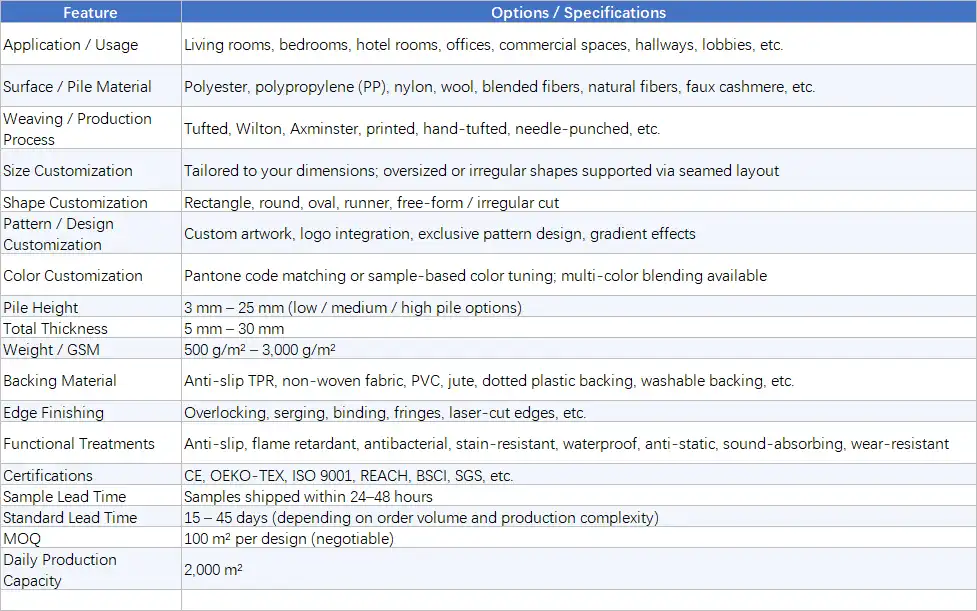
Commercial buyers shouldn't think that loop design lowers the quality of the image for a Textured Loop Carpet. Modern methods of production, like heat transfer printing and precise laser cutting, make it possible for loop pile rugs to have complex geometric designs, branded colors, and custom themes that stand out clearly. Solution-dyed fibers protect bright colors from light (AATCC 16.3), even in commercial spaces that get a lot of sun.
The main situations in which each style is most useful are listed below:
- Corporate and high-traffic zones: Loop pile construction is the industry standard for open-plan offices and hallways. Because it is built on several levels, it effectively hides wear patterns, keeping a professional look even after years of being stressed by caster chairs and foot traffic.
- Hospitality and senior living: Hotels use loop pile construction to give floors a carved feel while still being able to handle industrial cleaning cycles and rolling luggage carts. The low-profile, non-slip surface works well in senior living areas to support mobility aids, and the textured design gives the area a calm, non-institutional look.
- Retail and branded environments: Custom-printed loop pile carpet makes it possible to use the same visual marketing across franchise or chain store networks, where it's important that the pattern can be repeated across batches.
- Event and exhibition floors: Loop pile formats are great for trade show booths and temporary branded spaces that need to be set up quickly because they can be made quickly and come in a variety of patterns that can be changed.
Plush carpet is still the best choice for senior offices, boutique hotel rooms, and other places where tactile luxury is the main reason people buy something, and traffic stays low.
Making the Decision: Choosing Between Textured Loop and Plush Carpet for Your Business
The best way to make a procurement choice is to look at five factors in order: the expected amount of traffic, the budget for upkeep, the schedule for installation, the needs for customization, and the requirements for compliance. Most commercial procurement briefs are met by loop pile construction on all five counts: it can handle heavy use, cleans easily, can be installed on a large scale, can be printed and cut to order, and meets CE, OEKO-TEX, ISO 9001, and REACH standards when it comes from certified manufacturers.
It is appropriate to use plush carpet in situations where the client wants to prioritize comfort and style over durability. If you select plush in the wrong place—one with a lot of foot traffic, spills, or rolling equipment—it could need to be replaced early; the client would be unhappy, and the design or procurement company making the suggestion would lose its image.
A good relationship with the provider also plays a role in the choice. When manufacturers offer OEM/ODM flexibility, sample production in 24–48 hours, and delivery cycles of 7–15 days, procurement teams can easily adapt to changes in the project schedule without having to pay extra. Compliance paperwork, such as full test results, export certificates, and customs support, makes the buying process even less risky for people who work across borders and buy in both North American and European markets.
Conclusion
Textured Loop Carpet is better than plush carpet in almost every business measure that procurement professionals care about, including longevity, ease of upkeep, installation scalability, and the ability to be customized. Plush carpet still has real value in places with low foot traffic and a focus on style. A smart buying strategy uses each style where its qualities are most useful in real-world situations. This protects both the investment and the happiness of the end user. This important choice becomes a strategic competitive advantage when it comes from a manufacturer with certified quality systems, the ability to make samples quickly, and compliance credentials that have been checked.
FAQ
Why does loop pile carpet generally last longer than plush in commercial settings?
Loop pile fibers don't break when they are compressed or stressed laterally, but cut pile fibers in soft carpet bend, mat, and lose their straight shape when they are loaded for a long time. Looped construction directly extends service life in areas with a lot of traffic because it makes the structure more resilient.
Can plush carpet realistically be installed in busy commercial areas?
It can be set up, but it's not really up to the job. A lot of foot traffic speeds up the crushing of mats and piles in cut pile designs, making wear tracks that can be seen and making cleaning more often necessary. When compared to loop pile options, the lifetime cost becomes too high.
Are sustainable options available in loop pile formats?
Yes. A lot of approved makers make loop pile rugs with recycled fibers or solution-dyed yarns, which don't waste rinse water during the coloring process. Products that meet the standards of OEKO-TEX and CRI Green Label Plus are guaranteed to have low VOC emissions and come from responsibly sourced materials.
How do I prevent snagging in loop pile carpet?
Choose goods with high tuft bind rates according to ASTM D1335 and make sure they are installed by a professional so that seam sealer is used at all the seams. If a loop gets caught, cut it off cleanly. Never pull the loop, as this will unravel fibers next to it.
Get Custom Textured Loop Carpet Solutions From Bier — Request Your Sample Today
Bier brings 10 years of experience in manufacturing to every order. They use heat transfer printing, laser cutting, and full ISO 9001, OEKO-TEX, CE, and REACH compliance to build a stable supply chain for business projects around the world. As a reliable Textured Loop Carpet manufacturer, we send samples within 24 to 48 hours, ship large orders in 7 to 15 days, and give long-term partners their own account manager. To get your custom sample, email our team at sales@biercarpet.com or go to biercarpet.com.

References
1. Carpet and Rug Institute. CRI Carpet Specification Guide for Commercial Applications. 2022.
2. ASTM International. Standard Test Method for Tuft Bind of Pile Floor Coverings (ASTM D1335). 2021.
3. Floor Covering Weekly. Commercial Flooring Durability and Lifecycle Cost Analysis. 2023.
4. Shaw Industries Group. Commercial Flooring Performance Benchmarks: Loop vs. Cut Pile Constructions. 2022.
5. OEKO-TEX Association. OEKO-TEX Standard 100: Testing for Harmful Substances in Textiles and Floor Coverings. 2023.
6. Journal of Interior Design. Specifying Flooring for High-Traffic Commercial Environments: Material Performance and Procurement Considerations. 2021.
Send Inquiry
Related Industry Knowledge
- Custom Dimensional Rugs Improve Interior Design Value for Hospitality Projects
- Easy Care Carpet Delivers Practical Flooring Solutions for High-Use Areas
- Christmas Runner Rugs for Kitchen Add Warm Winter Vibes
- Premium Double Door Christmas Mat for Holiday Front Door Style
- The Ultimate Guide to Large Area Rugs for Nursery & Placement
- Washable Japanese Print Rug for Easy Home Maintenance
- How to Make a petal rug blend in with Your Surroundings?
- What Materials Are Used in Japanese Print Rug Production?
- Faux Cashmere Rugs: What They Actually Are and Why They Feel Different
- Discovering the Natural Charm of Jute Rugs