
How Can Buyers Source Simple Rugs for Living Room in Bulk?
Sep 14, 2026
Sourcing simple rugs for living room projects in bulk requires a structured approach that balances quality, customization, cost, and logistics. B2B buyers—whether purchasing managers, sourcing directors, or project contractors—need to evaluate material specifications, supplier capabilities, and compliance requirements before committing to large orders. The most reliable path involves working directly with verified manufacturers who offer OEM/ODM flexibility, rapid sample development, and export-ready logistics. By understanding market demand, defining procurement criteria, and vetting suppliers carefully, buyers can secure consistent, high-quality floor coverings that meet diverse commercial and residential application needs at competitive unit costs.
Understanding the Demand for Simple Rugs in Living Rooms
The market for simple floor coverings has grown a lot in the last few years around the world. A lot of neutral, low-profile area rugs that look good in modern living rooms without being too much are being bought in bulk by industries like restaurants, business real estate, and private interior design.
Grand View Research says that the world market for rugs and carpets was worth about USD 46.9 billion in 2022 and will continue to grow at a rate of 5.5% per year until 2030. Solid-color and texture-forward designs are becoming more popular in this space because they work as visual anchors in multifunctional rooms, keeping the space open while securing furniture arrangements.

Why Minimalist Rug Designs Dominate Commercial Procurement?
Simply designed rugs are always popular with commercial buyers because they don't need to be replaced as often. A patterned rug might not go with a new look for a store or a renovation of the lobby of a hotel. A neutral, well-made rug, on the other hand, can work with many different designs. This way of buying works for both short-term event sites and long-term hospitality contracts. For people who buy a lot of rugs, this makes them a smart investment.
Essential Criteria for Choosing Simple Rugs for Living Room in Bulk
Setting clear goals for procurement before involving suppliers protects buyers from costly misalignment. Scale, spending limits, the setting where the rugs will be used, and the end user's maintenance requirements must all be written down ahead of time.
Both function and cost are directly affected by the make-up of a material for Simple Rugs for Living Room. Polyester-fiber surfaces, like fake cashmere, feel soft and smooth against the skin and are much cheaper than real wool, which makes them great for large business orders. A TPR (Thermoplastic Rubber) base that is clean and doesn't slip adds functionality by giving a stable grip on tile and hardwood floors without leaving behind sticky residue.
When expert procurement teams look at bulk rug sales, these are the main material and structure factors they use:
- Surface fiber density: A gram weight of 1000 g/㎡ with a face fiber layer of 350 g/㎡ means that the surface is solid and won't mat down when people walk on it regularly.
- Pile height: A 3mm short-pile construction keeps dust to a minimum, allows for machine washing, and speeds up the drying process—all of which are important in places with a lot of foot traffic, like hotel rooms or serviced apartments.
- Total thickness: A 5mm shape keeps the rug from getting caught under doorways, which makes fitting easier in business settings.
- Edge integrity: A 0.6cm edge-locking stitch and high-density machine weaving keep the edges from coming apart, so the rug will look good after many cleanings and years of use.
These structural parameters directly lower the cost of maintenance and increase the useful life of the product, which are both very important in large-scale deployments. When buyers write these requirements down in their RFQ, they make their goals clearer and get more accurate quotes from suppliers.

Comparison of Rug Manufacturing Methods and Sourcing Options
Bulk buyers often compare products made by machines and those made by hand. Machine-woven rugs have consistent sizes and colors across big batches, and the wait time is always known, which are all important for business buying. Even though handmade rugs are unique in terms of art, they can be different sizes and take longer to make, which makes bulk scheduling harder.
Machine-Made Versus Factory-Direct Sourcing Channels
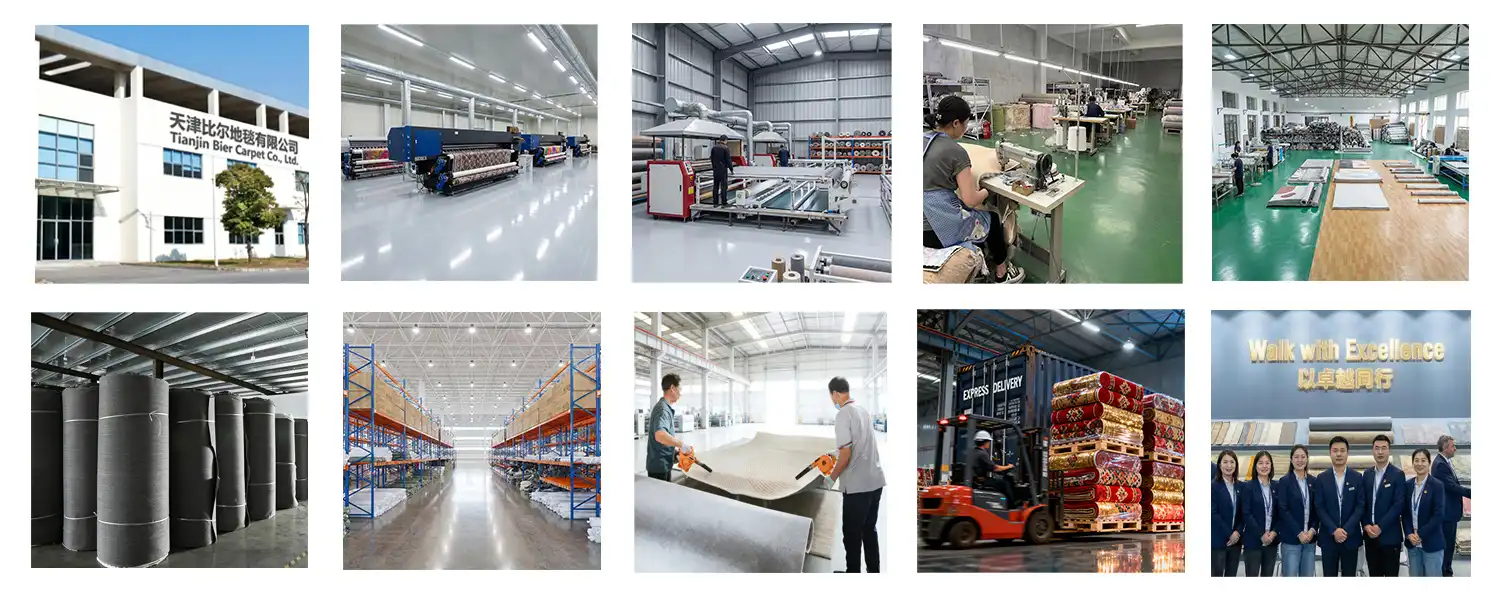
Factory-direct buying gets rid of the middleman's markup and lets you talk directly with the manufacturer about your customization needs. When buyers work with makers whose daily production capacity stays at 2,000 ㎡, they can usually get their orders filled within 7–15 days. This is a good amount of time to meet the needs of both seasonal shopping windows and event installation schedules. Distributors and online markets are convenient, but they don't usually offer as much flexibility or price advantages as working directly with manufacturers.
When choosing a purchasing route, quality certification is very important. Suppliers who follow OEKO-TEX Standard 100, ISO 9001, CE, and REACH can guarantee that their goods don't contain any dangerous materials and meet the safety standards of the US, EU, and Middle Eastern markets. It is common for experienced buying teams to ask for full test documents before confirming an order.
Best Practices for Procuring Simple Rugs for Living Room in Bulk
To do bulk sourcing right, you need to focus less on getting the lowest price and more on keeping risk under control throughout the whole order cycle. A structured buying process makes it less likely that there will be problems with quality, shipping delays, or failure to follow the rules.
It is necessary to ask for real samples before approving mass production of Simple Rugs for Living Room. Reliable manufacturers can make 1:1 pre-production samples in 24 to 48 hours, so buyers can check the color, surface texture, edge finishing, and size tolerances before committing to a production budget. By finding mistakes early, this sample-first method shortens the overall order cycle.
Planning strategically for transportation is just as important. Export-grade packaging that is resistant to pressure, moisture, and stacking, along with better estimates for how to load containers, directly lowers the cost of operations per unit. When buyers place FCL or LCL shipments, they benefit from suppliers who have long-term relationships with freight forwarders and in-house customs documentation teams. This lowers the risk of delays at the port.
After-Sales Infrastructure That Protects Bulk Buyers
How a seller handles help after a shipment shows how committed they are to working with you. A supplier with dedicated account managers for long-term clients, free rework or replacement for verified quality defects, and the willingness to cover the logistics costs of making these fixes is a lower procurement risk overall. This model for after the sale is especially useful for buyers who have to keep track of repeat orders across multiple retail cycles or phases of a hospitality project.
Emerging Trends and Future Outlook in Living Room Rug Procurement
Sustainability credentials are changing the requirements for buying things. More and more, buyers looking for brands that care about the environment, society, and the community want proof that the products they buy don't contain any azo dyes, heavy metals, or dangerous flame retardants. OEKO-TEX and REACH compliance directly address these issues.
Improvements in production technology are also speeding up stability in quality. Heat transfer printing locks color into fiber structures so that they don't fade, and precise laser cutting makes edges that are straight and don't fray. Quality checking systems that use AI are being added to production lines. This makes it possible to find defects on a large scale that can't be done by hand. For bulk buyers with tight delivery schedules, these changes in manufacturing directly mean that order outcomes are more predictable.
Digital procurement tools are making it easier to find suppliers and handle RFQs, which makes large-scale buying less of an administrative load. When buyers use digital buying tools along with direct relationships with manufacturers, they save time and have more bargaining power in B2B markets that are very competitive.
Conclusion
Buying minimalist Simple Rugs for Living Room in bulk requires accuracy at every step, from choosing the right materials and vetting suppliers to planning logistics and managing risks after the sale. Buyers who choose authorized, factory-direct suppliers with a history of customization, quick sample turnaround, and export-ready services always get better cost-per-unit results and fewer order problems. The market is moving in a way that strongly favors suppliers who use sustainable materials and advanced production technology. This makes choosing a seller one of the most important choices in the procurement cycle.
FAQ
How long does bulk order delivery typically take?
Lead times depend on the size and complexity of the order. Standard machine-woven mats that meet set standards can be delivered by suppliers with a daily production capacity of 2,000 ㎡ within 7–15 business days for most mass orders. Custom color matching or adding a logo may take an extra two to three days for approval of a pre-production example.
How do I verify quality before committing to a large order?
Ask for real pre-production samples and check the safety paperwork, especially the OEKO-TEX, ISO 9001, and REACH certificates. Compare the fabric's color fastness, edge stitching density, pile binding strength, and size accuracy to the requirements in your RFQ.

Can suppliers accommodate custom sizes and branding?
Yes, reputable OEM/ODM makers allow for custom color development, LOGO integration, and a range of different size designs. For regular customers, the minimum order quantity can often be changed, which makes tailoring possible even for buying programs that buy in bulk.
Are these rugs suitable for commercial high-traffic environments?
The 3mm short-pile construction, high-density machine weaving, and TPR non-slip backing make this carpet work well in hotel rooms, serviced flats, store showrooms, and business offices. The short pile doesn't mat and can handle being cleaned often.
Partner with Bier for Reliable Bulk Simple Rugs for Living Room Supply
Bier has been making things for 10 years and follows all CE, OEKO-TEX, ISO 9001, and REACH rules when they make something. As a reliable Simple Rugs for Living Room manufacturer, we offer samples within 24 to 48 hours, production cycles that last 7 to 15 days, and full support for export logistics. You can email our team at sales@biercarpet.com or go to biercarpet.com to ask for a sample, look through our store, or get a bulk quote that is specifically made for your project.
References
1. Grand View Research. Carpet & Rugs Market Size, Share & Trends Analysis Report. 2023.
2. OEKO-TEX Association. OEKO-TEX Standard 100: Testing for Harmful Substances. 2022.
3. International Organization for Standardization. ISO 9001:2015 Quality Management Systems – Requirements. 2015.
4. American Association of Textile Chemists and Colorists. AATCC Test Method 16: Colorfastness to Light. 2021.
5. Mordor Intelligence. Floor Covering Market – Growth, Trends, and Forecasts. 2023.
6. Textile Exchange. Preferred Fiber & Materials Market Report. 2022.
Send Inquiry
Related Industry Knowledge
- Why are jute nursery rugs the Ultimate Natural Home Decor Icons?
- Silk Thread Rugs vs Traditional Carpets: Key Differences
- Premium Christmas Tree Stand Mat for Modern Christmas Decorations
- Eco-Friendly Rugs: How to Make Sustainable Home Choices
- Why Round Rugs Are the Ideal Choice for Children's Rooms
- Large area rug for nursery: Stylish & Safe Choices for Cosy Baby Rooms
- Crystal Premium Crystal Velvet Rug Manufacturer & Supplier in China
- Dimensional rugs: Materials, Dimensions & Styling Principles Explained
- Chunky Loop Carpet for Modern Homes: Durable & Stylish Flooring
- Soft Flannel Carpet Rug for Bedroom Flooring