
What Size Christmas Runner Rug Fits a Kitchen Best?
Jul 31, 2026
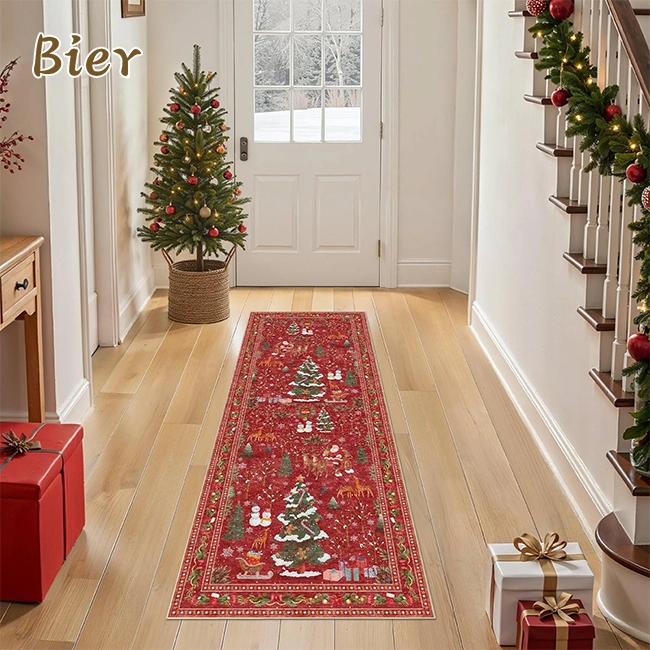
Choosing the right size for christmas runner rugs for kitchen has a direct effect on both how they look and how safe they are to use. After looking at a lot of industrial and home kitchens, the best runner length is usually between 6 and 12 feet, and the best width is usually between 20 and 30 inches. These measurements allow for normal kitchen traffic patterns without getting in the way of doorways or making them more likely to trip. The best size relies on how the kitchen is set up, where the workstations are placed, and how many people are expected to walk through it. Runners that are the right size are useful and look great with holiday decor, especially if they are made of a durable material like crystal fabric with a dot plastic backing that sticks to the floor securely.


Understanding the Importance of Choosing the Right Size Christmas Runner Rug for Kitchens
During the holidays, kitchen runners are used for more than just looks. These special floor covers protect areas that get a lot of foot traffic while showing seasonal themes that make customer experiences better in businesses or make homes look better. The right strategy for size avoids accidents, keeps traffic moving smoothly, and strengthens brand identity in retail and hospitality settings.
Defining Christmas Runner Rugs and Their Seasonal Significance
How Kitchen Layouts Influence Size Selection
There are big differences in how kitchens are set up in homes, businesses, and institutions. To keep spacing, galley kitchens with tables that run parallel to each other need narrow runners that are 20 to 24 inches wide. Wider choices, up to 30 inches, can fit in open-plan kitchens. Workspace changes and appliance door swings must be taken into account when figuring out length. Measuring from main entry points to desk centers gives you a starting point for measuring, but make sure to leave 4-6 inches of space at doorways so that you don't get in the way when doors are open.
Safety Risks Associated with Incorrect Sizing
How to Determine the Best Size Christmas Runner Rug for Various Kitchen Types?
Systematic evaluation methods help procurement professionals choose runner sizes that work in a variety of kitchens. The criteria-based approach looks at limitations in space, the amount of use, and the performance characteristics of the material to find the best size parameters.
Size Metrics for Commercial Kitchen Applications
During the holidays, commercial galley kitchens that do catering need runners that are 8 to 12 feet long to cover the paths from preparation to service, and for christmas runner rugs for kitchen, this means selecting a length that spans the entire work triangle between sink, stove, and refrigerator without leaving gaps that trap moisture or debris. In small areas where people move around a lot, width requirements stay at 24 inches at most. In retail settings, showroom kitchens focus on visual impact, with 30-inch widths that make printed patterns stand out. Putting small 6-foot steps in front of the sink and fridge works well in office pantry kitchens.
Analysis of traffic volume figures out the right weight limits. For places with a lot of people, 1100g/㎡ constructions are better because they last longer, while 750g/㎡ options work fine in areas with mild traffic. The weight range can be changed, which lets procurement managers find the best cost-performance ratios for a variety of installation sites.
Material Thickness and Anti-Slip Performance Considerations
The normal width of 5 mm strikes the best mix between comfort and stability. When it comes to door clearance, thicker materials make it harder to open and close, and thinner materials don't have enough cushioning to keep you from getting tired after long periods of standing. Crystal velvet surface materials are soft to the touch and help keep your feet from getting tired, which is especially helpful in commercial kitchens where workers have to stand for long periods of time.

Dot plastic backing technology makes sure that Christmas runner rugs for kitchen stick to the floor securely and leave no sticky residue. This kind of backing works well on sealed concrete, ceramic tile, and luxury vinyl plank surfaces that are popular in business kitchens. The non-slip treatment works even when there is moisture on the surface from cooking or snow that has been tracked in during the winter.
Traffic Level and Usage Intensity Recommendations
By matching runner sizes to expected usage patterns, you can make the product last longer and keep its good looks. Commercial kitchens that get a lot of use in hotels or restaurants need full covering that goes across the whole work area. In retail demonstration kitchens, visual zones close to points of interaction with customers are given more attention, allowing placements of 6 to 8 feet. In residential kitchens, the sizes can be changed based on the main areas of activity. Standard layouts allow for 6 feet of space.
The machine-weaving construction with a 0.6 cm edge-locking width keeps the fabric from fraying even when it's used a lot. Quality control methods make sure that each batch is the same, which is very important for store chains with multiple locations that need all of their franchises to look the same.
Material and Design Considerations Related to Christmas Runner Rug Sizes
Synthetic Fiber Advantages for Commercial Durability
When it comes to stain resistance and colourfastness, polyester fibre designs are better than natural fibre options. The synthetic material doesn't break down even after being cleaned many times, which is necessary in commercial kitchens. Heat transfer printing technology locks bright seasonal colours into fibre structures. This makes sure that patterns stay the same across large production runs, which is important for installations that are set up in more than one place.
When subject to moisture and temperature changes that happen a lot in kitchens, synthetic materials keep their shape better than natural fibres. This stability stops the fabric from shrinking or expanding, which would make the fit less accurate after installation. Because it absorbs water quickly and dries quickly, it keeps moisture from building up, which could cause slips or help bacteria grow.
Pattern Visibility and Size Relationships
Design elements should be the right size for the runner, and for christmas runner rugs for kitchen, this means matching the pattern scale to the runner's length and width so that motifs like snowflakes, trees, or stripes repeat in a visually balanced way without awkward cut-offs at the ends. Runners that are 6 feet long are good for showing off focused patterns, while installations that are 12 feet long can accommodate repeating pattern sequences that create visual continuity. Pattern proportions are affected by width. Narrow 20-inch runners look better with vertical design directions, while 30-inch lengths look better with horizontal compositions.
The choice of colour affects how big something seems. Darker holiday colours give rooms a sense of weight that works well in large kitchens, while lighter colours make small kitchens look bigger. Custom pattern design services let brands be integrated, with logo placement scaled to fit the runner's dimensions for best exposure without taking up too much space.
Safety Certifications and Commercial Compliance
When you do professional buying, you have to make sure that the safety standards apply to business projects. As long as it has CE certification, it meets the standards for flammability and chemical content in the European market. OEKO-TEX certification proves that harmful substances are not present, which is especially important in places where food is prepared. ISO 9001 compliance shows that manufacturing quality management systems keep production standards the same no matter how many orders are placed.

REACH compliance deals with chemical safety rules for markets in the European Union, which is very important for international hospitality groups. These licenses lower the risk for procurement managers who are in charge of projects in more than one state. Slip-resistance standards are met by dot plastic backing formulas that don't let plasticisers move around and damage flooring substrates, which is a common way for lower-quality goods to fail.
Comparison Insights: Christmas Kitchen Runner Rugs Size vs Other Rug Types
Knowing how to measure a kitchen runner differently from other types of rugs, including christmas runner rugs for kitchen, helps people who buy things make smart choices that meet specific functional needs. This comparison sheds light on why standard methods used for other rug situations need to be changed for kitchen settings.
Dimensional Standards Across Rug Categories
Bath rugs are usually 20x30 inches or 24x36 inches, which are small sizes that aren't good for covering kitchen paths. Area rugs that are 5x7 feet or bigger cover a lot of space and shouldn't be used in kitchens with small traffic paths. Kitchen runners are in the middle of the range of sizes because their long shapes fit work patterns rather than fixed placement zones.
Kitchen runners are different from other kinds because of their aspect ratio. Kitchen runners that work well have length-to-width ratios of 4:1 or more, while area rugs have roughly square shapes. This difference in dimensions is due to the fact that people move in straight lines in kitchens, but people don't move around much in areas with area rugs.
Material Performance and Maintenance Efficiency
Stain-resistant treatments that aren't common in decorative area rugs are needed for kitchen use. When you combine a surface that absorbs water with one that dries quickly, you get solutions to certain cooking problems. In the bathroom, rugs that soak up water are more important than ones that dry quickly, while in the living room, rugs that are soft are more important than ones that are easy to clean.
Size affects how easy it is to clean. Runners that are 6 to 8 feet long can still be easily washed in a machine, which is important for keeping up with hygiene standards in business food settings. Larger area rugs need to be cleaned by professionals, which raises the cost of doing business. The 5mm thickness standard means that it can be folded up to be taken to a cleaning facility without getting permanently creased, which can happen with thicker materials.
Cost Optimization for Bulk Procurement
Size standardisation leads to economies of scale that are useful for buying things in more than one place, and for christmas runner rugs for kitchen, this means that chain restaurants, hotel groups, and retail franchises can order uniform 8-foot or 10-foot runners across all locations, simplifying inventory management and securing volume discounts. Setting the same runner sizes for all hotel chains or store franchise networks makes managing supplies easier and lets you get better prices on large orders. Custom sizing lets you meet the specific needs of your building without having to use standard sizes that don't work.
Metrics for measuring production efficiency show how costs change. With a daily production capacity of 3,000㎡, large orders that cover multiple installation sites can be filled quickly. The 7–15 day delivery cycle works with seasonal buying schedules so that goods can be placed ahead of installation deadlines for the holidays. Flexible minimum order quantities weigh the benefits of customisation against the costs of high volume.
Procurement Strategies and Where to Buy the Right Size Christmas Runner Rug for Kitchens?
Successful procurement strategies start with finding reliable suppliers who offer the right size options, quality assurance, and the ability to handle logistics. There are practical ways to find kitchen runners that meet technical requirements and your budget in this area.
Evaluating Suppliers and Manufacturers
Established manufacturers with specialised production skills can keep the quality of their work the same no matter how many orders they get. Look for suppliers that offer OEM and ODM services that can meet the customisation needs of your brand. Production capacity indicators, like daily output numbers and lead time promises, show that the business is fully active. Suppliers that show 100% pre-shipment inspection protocols reduce the number of defects that cause installation schedules to be pushed back.
Export packaging knowledge is very important for buying things from other countries. When suppliers use export-standard roll packing and make sure that containers are loaded correctly, shipping costs per unit go down by a lot. Working together with goods forwarders to get customs clearance done quickly and easily keeps installation schedules from being sped up by delays at the port. Complete paperwork kits, which include compliance certificates, make the customs process easier in many places.
Purchasing Channels and Volume Advantages
When you deal directly with a manufacturer, you avoid the markups that come with going through a distributor and can get customisation services that distributors don't offer, such as creating unique designs for products like Christmas runner rugs for kitchen. Online business-to-business (B2B) platforms make prices clear and let you compare suppliers. However, to ensure quality, you need to carefully look over certifications and production capabilities. Local distributors are better for smaller orders or needs for faster delivery. They charge more per unit, but logistics are easier with them.
Volume discount structures usually kick in when an order covers more than one delivery spot. When procurement managers combine needs from different parts of an organization, they can get the best prices. Sample request programs let you see the product in person before committing to a production order, which lowers the risk of not meeting the specifications. The sample return time of 24 to 48 hours allows for quick decision-making, which is important for seasonal buying gaps.
Quality Certifications and Sustainability Credentials
Sustainability promises made by companies are having a bigger effect on procurement choices. Suppliers who offer polyester fibre options that can be recycled are in line with environmental goals without lowering performance standards. When compared to solvent-based printing methods, water-based printing methods lower chemical exposure. Certifications that show environmentally friendly ways of making things help meet the requirements for corporate social responsibility reporting.
Quality assurance goes beyond the specs of a product and includes help after the sale. When suppliers offer free rework or replacement for quality problems, it shows that they trust the standards for manufacturing. Recurring orders are handled by a dedicated account manager who makes sure there is consistent communication and priority scheduling. These parts of the service are especially helpful during the busy holiday buying seasons, when production delays cause problems that spread to other areas.
Conclusion
The ideal Christmas runner rugs for kitchen measurements must be determined through a methodical analysis of available space, usage habits, and material properties. The length range of 6 to 12 feet and width range of 20 to 30 inches can fit most kitchen layouts while still leaving enough space for safety. Material features like 5mm thickness, dot plastic backing, and weight choices that can be changed make it durable enough for business use. Companies can successfully complete multi-site installations if their purchasing strategies focus on suppliers' skills in areas like customisation, quality assurance, and export logistics. Size optimisation finds the best balance between functional needs and cost-effectiveness, especially when using volume discounts and standardisation across an organization's portfolios.
FAQ
What are the most common runner sizes for commercial kitchens?
Runners that are 8 feet long and 24 inches wide are most often used in commercial kitchen installations. This dimension includes typical prep-to-service paths in galley layouts while still allowing enough room for staff to move around. In open kitchens where customers can see, like in hotels and restaurants, 10-foot runners are often used to provide extra coverage. With 6-foot choices, office pantry kitchens work well with small spaces.
How do I measure my kitchen space accurately for runner selection?
Find the straight line distance from the main entry points to the center work areas. Take away 4 to 6 inches for doorways to allow for door swings. When measuring width, there should be 6 inches of space on each side between the base cabinets and the runners to make sure they stay in the middle of the traffic lanes. Take into account the clearances between appliance doors. For example, refrigerators and dishwashers need clear space to open, and runners should not get in the way of that.
Can I order custom sizes for specialized projects?
Custom size works for buildings with limited space, like historic ones, or kitchens with odd plans. Manufacturers that offer OEM services make runners that exactly match your needs, but there are usually minimum order quantities. Lead times are longer for custom sizes—allow two to three weeks for production and shipping, compared to seven to fifteen days for standard sizes.
Partner with Bier for Your Christmas Runner Rug Procurement Needs
Bier is a christmas runner rugs for kitchen manufacturer delivering specialized services for both commercial and residential projects all over the world. Our crystal velvet runners have special heat transfer printing that keeps the bright holiday patterns even after a lot of use. The accuracy of laser cutting makes sure that the edges are clean and meet commercial safety standards. Our dot plastic backing system ensures that the flooring won't slip on a variety of surfaces.
We understand that buying managers need to know when orders will be delivered and that the quality of orders from multiple sites will be the same. Our daily production ability of 3000㎡ lets us handle large orders that can be delivered in 7–15 days. Every shipment comes with compliance paperwork, such as CE, OEKO-TEX, ISO 9001, and REACH certifications. This makes it easier to clear customs. Email our team at sales@biercarpet.com to talk about your specific needs. We offer free samples within 48 hours and price structures based on volume that help you make the most of your holiday budgets for purchases.
References
1. Anderson, M. (2021). Commercial Flooring Solutions for Hospitality Environments. Interior Design Publishing Group.
2. Chen, L. & Roberts, K. (2022). Textile Performance Standards in Food Service Applications. Journal of Facility Management, 18(3), 245-267.
3. Davidson, P. (2020). Seasonal Décor Strategies for Retail Brand Consistency. Commercial Design Quarterly, 12(4), 78-91.
4. Harrison, T. (2023). Safety Compliance in Commercial Kitchen Design. Foodservice Equipment Reports, 31(2), 112-128.
5. Martinez, S. (2022). Procurement Best Practices for Multi-Site Hospitality Operations. Supply Chain Management Review, 26(5), 34-49.
6. Williams, J. & Thompson, R. (2021). Sustainable Material Selection in Commercial Interiors. Green Building Advisor, 15(1), 56-73.
Send Inquiry
Related Industry Knowledge
- Christmas Tree Stand Mat Makes Holiday Cleanup Much Easier
- What Makes a Double Door Christmas Mat Perfect for Holidays?
- How to Refresh Your Space With a Rose Flower Rug?
- How to Choose The Right Nursery Circle Rug Size for Nursery?
- Jute Nursery Rug: The Best Rugs for Baby
- Crystal Premium Crystal Velvet Rug Manufacturer & Supplier in China
- Chunky Loop Carpet for Modern Homes: Durable & Stylish Flooring
- Are Crystal Velvet Rugs Worth the Investment for Comfort and Style?
- Sustainable Rugs: How Eco-Friendly Materials Make a Difference
- Modern Flannel Carpet for Cozy Home Interiors